Key Takeaways
- Patellar tendinopathy— “jumper’s knee”—is a load-related breakdown of the patellar tendon at the bottom of the kneecap, and it affects roughly 1 in 3 basketball players at some point.
- Rest alone does not fix it; the tendon needs progressive load to rebuild, and the most effective programs use isometric holds plus heavy slow resistance (HSR).
- Isometric quad exercises can reduce tendon pain within minutes and let athletes keep training while the tendon adapts.
- Heavy slow resistance training performs as well as classic eccentric protocols and is often easier to stick with, with meaningful gains over 8–12 weeks.
- Early, guided rehab prevents the chronic, season-stealing version of jumper’s knee that can linger for months.
The 2026 NBA Finals Are a Jumper’s-Knee Laboratory
Watch the 2026 NBA Finals and you are watching the exact load that creates jumper’s knee: thousands of explosive jumps, hard decelerations, and awkward landings on tired legs. It is no surprise that patellar tendinopathy has an estimated prevalence near 32% in basketball players. The condition rarely makes the injury report because athletes play through it—until the dull ache under the kneecap becomes a sharp, season-limiting problem. At POW PT, our patients with jumper’s knee get better not by resting, but by loading the tendon the right way.
Short answer: Patellar tendinopathy (jumper’s knee) is best treated with progressive loading, not rest. The most effective rehab combines isometric quad holds—which can ease tendon pain within minutes—with heavy slow resistance training that rebuilds the tendon’s capacity over 8–12 weeks. Pain that stays at or below a mild, tolerable level during and after exercise is the green light to keep progressing.
The Science: Why Tendons Need Load, Not Rest
The patellar tendon connects the kneecap (patella) to the shinbone and absorbs enormous force every time you jump or land. Patellar tendinopathy is not classic inflammation—it is a failed healing response in which the tendon’s collagen becomes disorganized and the tissue loses its ability to handle load. That distinction is everything. Pure rest temporarily reduces pain but also de-conditions the tendon, so symptoms come roaring back the moment you return to sport.
Two loading strategies have the strongest evidence. Isometric exercise—holding a heavy contraction without moving the joint, such as a wall-sit or a sustained leg-extension hold—produces immediate pain relief and begins rebuilding tendon tolerance, which makes it ideal for in-season athletes who cannot stop competing. Heavy slow resistance (HSR) uses slow, controlled, heavy knee-extension and squat or leg-press movements; research shows HSR is equivalent to traditional eccentric-only protocols and is often easier for patients to complete. A 2024 meta-analysis found eccentric, isometric, and HSR training were all effective for reducing pain and restoring function in patellar tendinopathy. The common thread is progressive, monitored load—not avoidance.
The Solution at POW PT
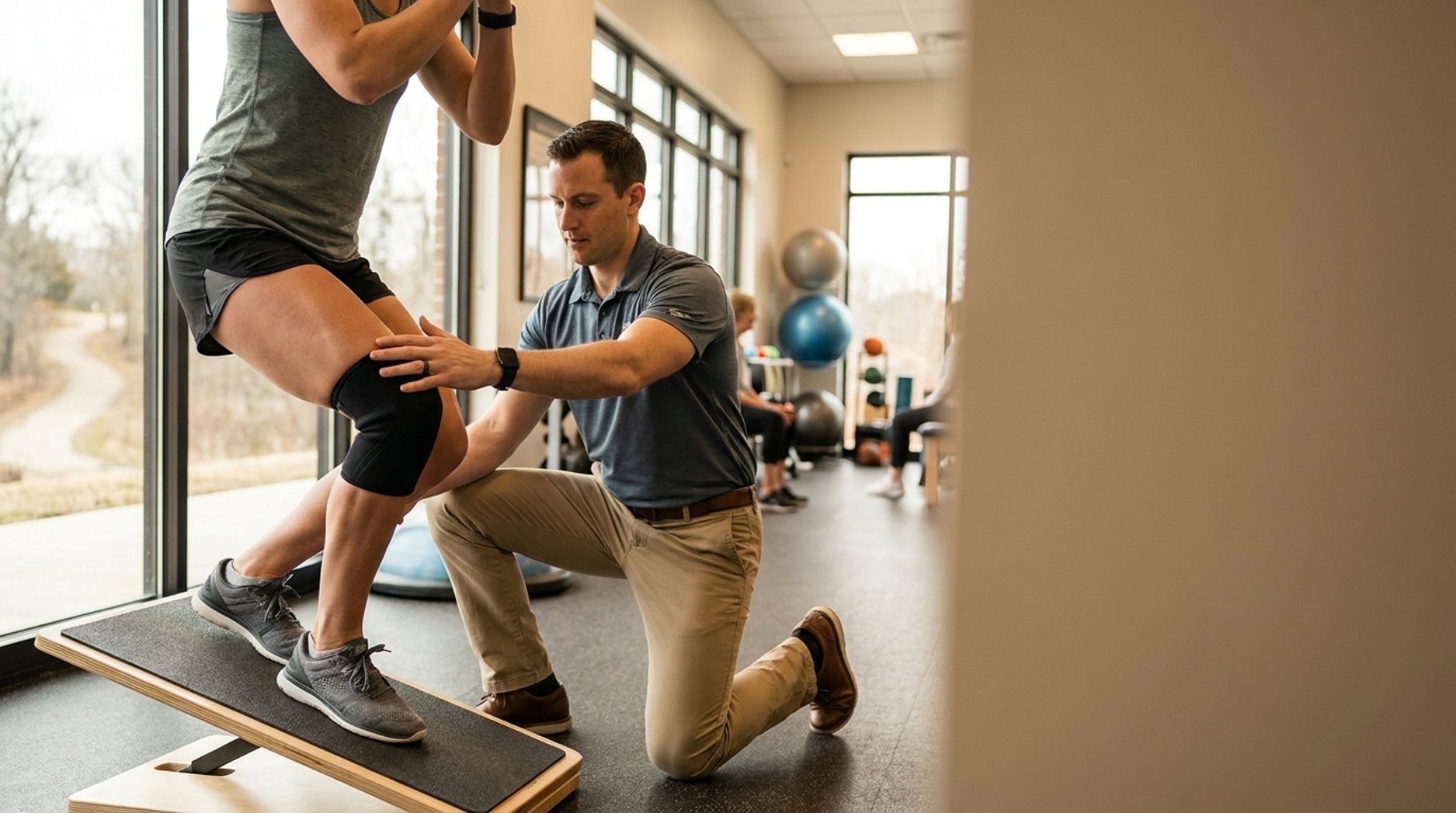
At POW PT, physical therapy is led by Dr. Josh Lombardi, DPT, CSCS, who builds jumper’s-knee rehab around the tendon’s need for load and the athlete’s need to keep training. A typical progression looks like this:
- Calm the pain and start adapting: heavy isometric holds (for example, 5 reps of a 30–45 second sustained quad contraction) several times per week to reduce pain and re-introduce load.
- Build capacity with heavy slow resistance: slow, heavy knee extensions, squats, and leg press performed with deliberate tempo, progressing load as the tendon tolerates over several weeks.
- Restore power and elastic energy: once strength returns, we reintroduce controlled plyometrics and sport-specific jumping and landing mechanics.
- Return to sport on objective criteria: symmetry in strength and hop testing, and pain that stays low during and the morning after training, guide the timeline—not the calendar alone.
We use a simple pain-monitoring rule: mild, tolerable pain during loading that settles by the next morning is acceptable and even productive. Pain that spikes and lingers means we adjust the load. Because POW PT sits inside Dr. Prisk’s orthopaedic practice, athletes who need imaging, a biologic option, or a surgical opinion have that pathway under one roof—though the vast majority of jumper’s knee never needs it. In Pennsylvania you can start physical therapy through direct access, so you do not have to wait for a referral to begin.
Frequently Asked Questions
Should I rest my jumper’s knee until the pain goes away?
No. Complete rest reduces pain temporarily but de-conditions the tendon, so symptoms return when you resume sport. The tendon rebuilds through progressive load—isometric holds and heavy slow resistance—while keeping pain at a mild, tolerable level. Guided loading, not avoidance, is the evidence-based fix.
How fast do isometric exercises relieve tendon pain?
Isometric quad holds can reduce patellar-tendon pain within minutes and the effect can last for hours, which is why they are often used right before practice or competition. They also begin rebuilding the tendon’s tolerance to load, making them a cornerstone of in-season rehab.
What is heavy slow resistance training?
Heavy slow resistance (HSR) is slow, controlled, heavy strength work—knee extensions, squats, and leg press—performed with a deliberate tempo such as three seconds up and three seconds down. Studies show it works as well as classic eccentric programs for jumper’s knee and is often easier to maintain.
How long until I can play again?
Most athletes feel meaningful improvement within 8–12 weeks of consistent loading, but return to full sport depends on objective strength and hop-test symmetry plus low, stable pain—not a fixed date. Rushing back before the tendon’s capacity is restored is the most common reason jumper’s knee becomes chronic.
Do I need a referral to start physical therapy in Pennsylvania?
No. Pennsylvania has direct access to physical therapy, so you can begin evaluation and treatment at POW PT without a physician referral. If imaging or a specialist opinion becomes necessary, our connection to Dr. Prisk’s orthopaedic practice makes that hand-off seamless.
Take the Next Step
If anterior knee pain is creeping into your training, get ahead of it before it steals your season. Call Prisk Orthopaedics and Wellness at (412) 525-7692 or schedule online at orthoandwellness.com to start a tendon-loading plan built for your sport.
About the author: Victor R. Prisk, MD, is a board-certified orthopaedic surgeon specializing in foot, ankle, and sports medicine and the CEO and Medical Director of Prisk Orthopaedics and Wellness, P.C. A former competitive gymnast and bodybuilder and the author of The Leucine Factor Diet, he partners with the POW PT team at P.O.W. and P.O.W.Fit to keep athletes loading, training, and competing.
