 Key Takeaways
- An anti-gravity treadmill uses air-pressure technology to reduce an athlete's effective body weight in precise increments, allowing pain-free running while healing tissue is still protected.
- Originally derived from NASA differential air-pressure technology, these treadmills can unload body weight in roughly 1% steps, down to about 20% of body weight.
- Anti-gravity training lets athletes maintain cardiovascular fitness and running mechanics weeks earlier than full-weight running, while preventing the disuse atrophy that slows comebacks.
- It is most valuable after foot and ankle injuries — stress fractures, Achilles repair, ankle sprains, and post-surgical recovery — where ground reaction force must be reintroduced gradually.
- The treadmill is a tool, not a shortcut: it works best inside a criterion-based return-to-run program supervised by a physical therapist.
Running on the Bone Before It's Fully Healed
Every World Cup, the same drama plays out: a star races the calendar to return from a foot or ankle injury in time for the tournament — and the 2026 FIFA World Cup, running June 11 to July 19, is no exception. Behind those comebacks is a quieter revolution in rehab technology. One of the most useful tools is the anti-gravity treadmill, which lets an injured runner log real running miles before the healing foot or ankle could tolerate full body weight on solid ground. For anyone returning from a stress fracture, an Achilles repair, or ankle surgery, this is the bridge between 'cleared to walk' and 'cleared to play.'
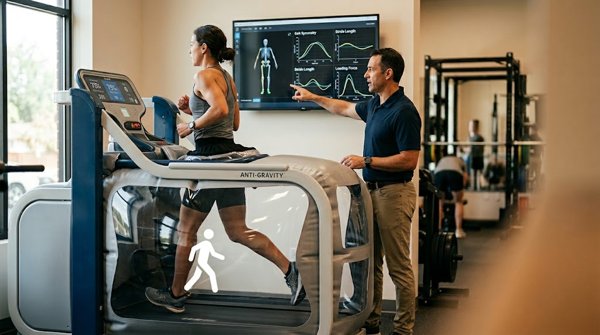
Short answer: An anti-gravity treadmill uses a sealed air-pressure chamber to lower your effective body weight in precise increments, so you can run with reduced impact while a healing foot or ankle is still vulnerable. It protects tissue, preserves fitness and gait mechanics, and — used within a supervised return-to-run program — speeds a safe comeback after lower-extremity injury.
The Science: How Unloading Speeds Recovery
The anti-gravity treadmill grew out of NASA differential air-pressure (DAP) technology. You step into a treadmill enclosed by a sealed chamber zipped around your waist; the chamber gently pressurizes and lifts you, reducing the load that travels through your legs with every footstrike. The unloading is precise — adjustable in increments of about 1% of body weight, down to roughly 20% — so a clinician can dial in exactly how much impact your healing tissue is ready to absorb.
Why does that matter? Running generates ground reaction forces of several times body weight at each step. After a navicular or metatarsal stress fracture, an Achilles repair, or ankle reconstruction, those forces are exactly what the healing structure cannot yet handle. By cutting effective body weight, the anti-gravity treadmill lets the athlete reintroduce the running motion at a fraction of the load, then progressively add weight as healing allows. The published rehab literature supports antigravity training as a way to protect healing tissue while still providing aerobic exercise and preserving normal gait mechanics (Level III–IV evidence).
The benefits stack up. The athlete maintains cardiovascular conditioning that would otherwise erode during weeks of restricted weight-bearing. Running mechanics and neuromuscular patterns stay sharp, so the comeback is not starting from zero. And critically, the athlete avoids the disuse atrophy — loss of muscle and aerobic capacity — that makes so many returns feel like learning to run all over again. Done correctly, unloaded running keeps the engine running while the chassis repairs.
The Solution at P.O.W. — POW PT
At POW PT, Dr. Josh Lombardi, DPT, CSCS, uses progressive unloading as one instrument in a full criterion-based return-to-run orchestra — never as a stand-alone fix. The sequence matters. Before an athlete runs at any body weight, we confirm they have the foundation: full, pain-free range of motion, restored calf and intrinsic foot strength, and the ability to load the limb in single-leg tasks. Only then do we introduce unloaded running, often starting at a heavily reduced body weight and adding load in small, tolerated steps.
Because POW PT works hand-in-hand with Dr. Prisk's surgical practice, the running progression is synchronized with the biology of your specific injury and procedure — we are not guessing about whether the bone or tendon is ready, because the surgeon and therapist are reading from the same chart. We pair unloaded running with gait analysis and wearable-sensor feedback to clean up mechanics, and we advance you by passing benchmarks — strength symmetry, hopping tests, pain-free tolerance — rather than by the calendar. The result is a return to running that is earlier, safer, and more durable than waiting on the sidelines for full weight-bearing to feel comfortable.
Frequently Asked Questions
What is an anti-gravity treadmill and how does it work?
An anti-gravity treadmill is a treadmill surrounded by a sealed air-pressure chamber that zips around your waist. The chamber pressurizes and gently lifts you, reducing your effective body weight in precise increments. This lowers the impact traveling through your legs with each step, so you can run with far less load while a healing injury is still protected.
Who benefits most from anti-gravity treadmill training?
Athletes and active people recovering from lower-extremity injuries benefit most — including foot and ankle stress fractures, Achilles tendon repair, ankle sprains and reconstructions, and post-surgical recovery. It is also useful for runners managing overuse injuries and for heavier individuals who need to reintroduce impact gradually while building fitness.
Can I really run sooner with an anti-gravity treadmill?
Often, yes — but only when the foundation is in place. By reducing impact, unloaded running lets many athletes resume the running motion weeks before full-weight running is safe. It is not a license to skip healing; it is a way to train within what your tissue can tolerate. Your physical therapist sets the body-weight level and progression based on your specific injury.
Is an anti-gravity treadmill better than running in a pool?
They are complementary tools. Aquatic running also unloads the body and is excellent very early in recovery, but it changes running mechanics significantly. An anti-gravity treadmill preserves a more natural running gait while still reducing impact, which makes it especially valuable in the later stages of a return-to-run progression. Many programs use both.
How do I know when I'm ready to progress to full body weight?
Progression should be criterion-based, not calendar-based. You advance when you can run at a given body weight without pain or compensation, demonstrate symmetric strength and hopping ability, and tolerate the added load over successive sessions. A supervised program tracks these benchmarks so each increase in body weight is earned rather than rushed.
Start Your Return-to-Run Program
Recovering from a foot, ankle, or lower-leg injury and itching to run again? Let our POW PT team build a return-to-run plan around your timeline and your goals. Call Prisk Orthopaedics and Wellness at (412) 525-7692 or schedule online at orthoandwellness.com.
About the Author
Dr. Victor R. Prisk is a board-certified orthopaedic surgeon specializing in foot, ankle, and sports medicine and the CEO & Medical Director of Prisk Orthopaedics and Wellness, P.C. (P.O.W.). A former NCAA gymnast and competitive bodybuilder, he is the author of The Leucine Factor Diet and brings a performance-medicine lens to every patient. He practices alongside the P.O.W. and P.O.W.Fit teams in the Pittsburgh region.
